Showing posts with label tours. Show all posts

Thursday, 11 November 2010

Coffee Beans and Chick vs. Chicken

Manizales, Colombia

We visited a beautiful coffee Finca in Manizales called Hacienda Venecia to see and taste how good coffee is made. Please excuse the length of this post, a lot of coffee had been consumed.


The Finca is at 1300m altitude and has 160 hectares of Arabica coffee plants – this makes them quite a large producer in comparison to the average Colombian coffee farm, which are around 5-10 hectares. There are two main types of coffee, Arabica and Robusta. Robusta is generally grown between sea level and 800m, but because Colombian farms are at a higher altitude only Arabica is grown.

Arabica coffee is generally considered to make a higher quality roast, with greater flavour and aroma. Our guide, Alex, explained the production process of washed Arabica bean from cultivation and picking through to processing and roasting.

Roasting some fresh beans!

For more information on the tour visit


Cultivation

Plants are grown from seed in bags of composted coffee berry flesh. They use the berry flesh because it is a nutrient rich waste product of the production process, and the seedlings remain in these bags for four to six months.

Preparation of the seedlings

Compost pile
An older plant after pruning

Picking

Since Colombia is near the equator the climate is such that the plants produce berries all year round. This contrasts with other countries such as Brazil where there is one distinct harvest season. In Colombia, you can therefore see red and yellow berries (those ready for picking) and green berries, flowers and buds (developing berries) all on one plant.


Despite the consistent temperature, there are two main harvest periods in Colombia. High season is between September and November, when 75% of the picking is carried out, and March to May, when the remaining 25% are picked.

According to the guide, teams of 40 to 60 people do the picking with one supervisor per team whose job is to oversee the process and control quality. In the high season, Hacienda Venecia have between 400 to 500 workers on the farm. One team can pick between 5000 to 10000kg per day depending on the season, and the pay varies between 300 to 1000 pesos per kilo – again, this rate depends on the season due to the abundance of beans and therefore the ease of amassing a greater quantity.

Working with the average figures though, this would mean that 1 person picks 150kg per day, earning 97500 pesos - about £30.

Process

Get ready for more facts and statistics. The berries are received and the quality of the batch is assessed. You don’t want too many green berries in the batch because these produce ‘quakers’ when roasted. Other problems that affect the quality of the harvest include insect damage from broca – a type of insect that eats the berries, and fungal infections on the berries before or after processing.

Collection area
Red and Yellow Berries
The beans are collected and washed down into a deep vat some 5m deep. When in water, berries with insect damage tend to float because of the hollow centre the broca cause and therefore these can be easily separated.

Separation Vat

The remaining beans are passed through machinery that removes the first fleshy outer layer of the berry – this wastage goes to the compost pile. When berries are picked the sugars of this fleshy layer cause fermentation to begin and therefore whilst the picking of berries is done during the day, the processing takes place the same night to reduce the damage caused.

Flesh removal machinery
Once the outer layer is removed, the beans need to be dried to prevent infection and fungal growth. At Hacienda Venecia, they opt for an oven process as opposed to sun drying, here the beans are gradually dried over a period of 18 to 24 hours at a temperature of 40 to 50 degrees. The beans need to have just 12% humidity before they are ready to be put into bags. They leave the second shell on the bean for protection during storage and exportation.

Coffee mountains


Wet beans pre-oven
Checking the humidity levels
A bag of 70kg costs about £125 and these are exported where the rest of the process (shell removal and roasting) is carried out to produce the brown coloured coffee bean we recognise. Their top three markets are Japan, Belgium and Canada.

The finished product
Coffee bean with inner shell
And with shell removed - this is what roasted coffee beans are made of

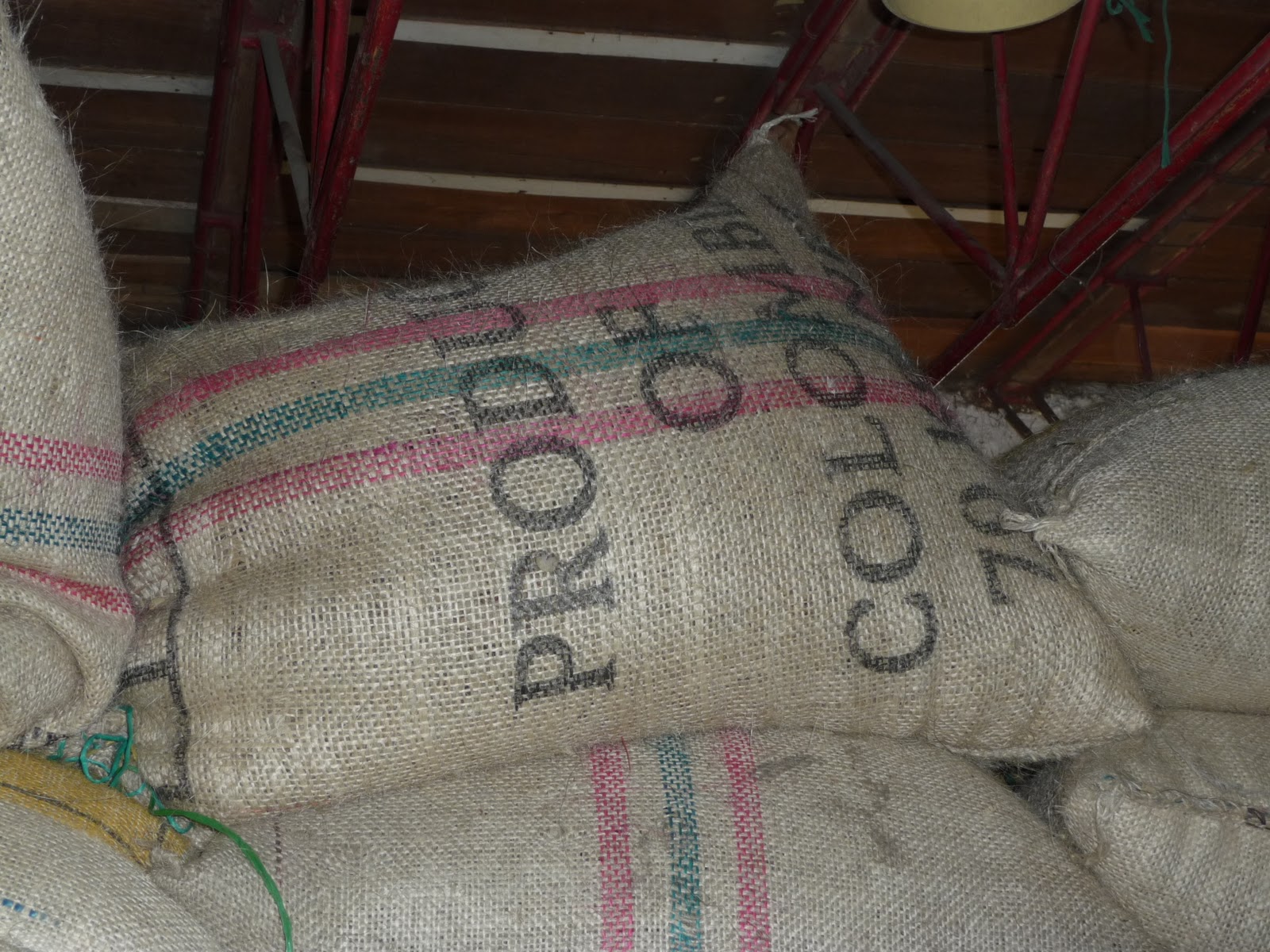
Sacks ready for export

According to Alex, the biggest importers in the world are obviously the U.S. but much of this is simply roasted and exported on again. Per capita, the biggest coffee drinkers are apparently the Philippines and Demark, the latter are also the biggest importers per capita.

The aroma and taste of coffee varies in a similar way to wine, the myriad factors affecting which include bean variety, climate, soil characteristics, roasting etc. and we had a lot of opportunity back at the ranch to explore this.


mmmm
Good coffee beans
... and the quakers
Coffee taste & aroma wheel


Wednesday, 20 October 2010

Bolivian Jungle Trek from Rurrenabaque

So I'm going to make a start on catching up with the blog posts and what I've been up to over the last month, no easy feat as its been pretty action packed! Anyway, first and foremost - our trip into Bolivian Amazonia.

We started our tour in Rurrenabaque, its quite a nice little town on the outskirts of the jungle. We arrived early and found this little bakery owned by a french guy. It was just opening and we had a couple of pan au chocolates straight from the oven. I reckon you'd be hard pushed to find a better place to get breakfast in South America. They were amazing.

As far as the details on prices and everything go for those of you interested I'm afraid I can't actually remember what we paid for the 3 night and 4 day excursion. What I do know, is that being Bolivia, it is one of the cheapest places you can organize a jungle trip from, and there is the added advantage that it is a low risk area for malaria, so you don't need to take any crazy pills.

It takes about 2 hours to get to the boat from the town, and it is one of the bumpiest roads I have travelled on. That didn't stop me from falling asleep anyway, much to the amazement of the other passengers.


Floating down the river we saw loads of wildlife, especially alligators and giant rat type things, lots of birds and once a monkey far off in a tree. We had to get out and push the boat a few times because we did the trip before the start of the wet season. You soon realize that the alligators are a lot more scared of you than you realize. In fact, by the end of the trip we were swimming in the river with dolphins while the alligators watched from the banks.

We stayed in this awesome kind of tree house come jungle lodge which was brilliant to watch the sunset from and listen to the sound of the jungle and the insects around you of a night. They had a nice room full of hammocks which was great to relax in too.

On the second day we went looking for anacondas and managed to find a few buried in holes in a field which was pretty cool. The best part of the trip for me however was the piranha fishing on the last day. Unfortunately it had rained a lot the day before, which meant that the water was more silty than usual and this stops the fish from sensing where the meat is as well, but their appetite was still pretty voracious considering how many times they got the bait off my hook. Eventually I managed to get one, and I later fed him to an alligator. Ken, another guy from our group managed to catch an eel and fred caught a kind of catfish thing. Don't think any of the catches would have sustained us that well though. Good job we had a chef back at the ranch, who, like most chefs on these tours, excelled in making pretty horrible tasting soups with bits of potatoes floating in. Lovely!

On the journey back from fishing though it was really dark, and as we maneuvered through meanders in the river our headlamps caused red reflections in the menacing eyes of the congregations of alligators waiting quietly in the water. The photos don't do it justice but that image of loads of glowing eyes is one of the most memorable things about the trip.

Thursday, 29 July 2010

Going Down To Devil Town

Potosi, Bolivia

I went down a private mine in Potosi yesterday. The mine was once government owned but it has now been privately owned since the 1990's. It was quite a nerve-racking experience, especially after I discovered on the way there that there are approximately 200 cave-ins somewhere in the mountain each year.


Reassuringly, the guide told me 'it's like a big piece of edam cheese in there, and there's a lot of pressure from locals for miners to stop working there'

Fortunately, the most dangerous parts of the mine are at the very top levels, and we were at the base of the mountain where the rock is not as wet and the predominant mineral is zinc. At the top though, there is more valuable silver, and miners regularly risk their lives to obtain it.

We put on overalls, boots, a hard hat and headlamp and ventured in to the mines. It was exactly how you'd imagine an old mine out of some western film; iron rails on the ground for trolleys to whizz along on, with wooden rafters supporting the roof and a line of bare light bulbs disappearing around the corner.


The air got hotter and dustier the further we walked, and my breathing got heavier as I struggled to get oxygen. Suddenly, a distant rumble prompted the guide to shout,

'Trolley! Quickly, get to the side! Come on!'

Like a herd of panicked antelope we all started rushing around to try and find a cove to squeeze into at the side. I must admit I was genuinely scared for my life as the approaching rumble got louder and I still hadn't got to safety. To my relief I squeezed into a spot, then as I saw the trolley approach, pulled by miners, travelling slowly at about 4 miles per hour I felt a bit stupid. Then again, everyone was the same - in the dark, unfamiliar environment we were all paranoid.


The guide pointed to a tunnel of the side of the main track, just big enough to crawl through, and on our hands and knees we followed behind. The tunnel climbed up and down, and at one point we had to crawl on our bellies to get through a tiny dark gap. We reached an opening and some miners, with sacks of rocks on their back, scuttled past. Our guide gave them some water and cocoa leaves we had brought as presents.

The guide congratulated us on getting past the hardest part 'many tourists turn back at that point' he said. For me, however, the most dangerous part was still to come. As we descended a ladder to get back on to another rail track, there came a call from above and the guide shouted for me to stay where a was. A few seconds later and a huge wooden support rafter fell from above, right between me and the rest of the group ahead. 'Quickly' the guide shouted and the rest of us ran past the beam to catch up with the rest of the group.

We stopped for a while with a resting miner, and the guide gave him some more of our gifts. His job was to shovel the contents of each 2 ton trolley into a pile where it would be winched up the following day. He had to move 40 tons of rubble before leaving. I helped him shovel for a bit, and after 5 minutes I was absolutely knackered. I'd done my fair share of shoveling saving up for this trip, but down there with no oxygen, in the hot dusty environment I could hardly breath. It was an eye opening experience, these miners have to be really tough to cope with the conditions. When you think there are kids as young as 15 down there helping their dads, its like going back to the 1900's.


The guide told us that this guy has it easier than most. To extract the minerals the miners have to make holes in the side of the rock, then, place dynamite in there, run and then shovel the rubble created into the trolleys to be to sent of for processing. These holes can me made in one of two ways; either by hand - a process which produces less dust but is slower, or with pneumatic machinery - fast, but very, very dusty. A miner using machinery can make 400 Bolivianos a day (£40), which is a lot of money for a Bolivian. However, these miners have a life expectancy of 10 years before developing the fatal 'black lung'. Our guide's uncle died of cancer at 37.

This isn't a 'nice' tour if you're thinking of doing it, but it was definitely a big shock to see the conditions that some people work in every day. The organization is structured in such a way that it takes 3 years of working in the mines to become a 'member'. Then, after working there longer, you can work your way up to the position of leader. You can pass you're leadership position on to your son when you die or are no longer able to work, and so - because of the time and effort invested by fathers in the mines - you have situations where families work and die for generations in these mines. Our guides father worked as a leader, and he explained the pressure he faced from his family to continue in his father's footsteps.


We saw a shrine to the Devil, the tradition of offering him presents; llama sacrifices, cocoa leaves, cigarettes etc can be traced back to the Spanish, who tried to use the devil to instill fear in the Indians taking silver from the mines. The symbol had an opposite effect, as the workers didn't see him as a 'bad' God. Rather, one to appease with presents in exchange for less accidents and the discovery of better mineral deposits. Even today, you'd never hear a miner exclaim for God - this is strictly the devils domain.

Before heading off, we witnessed the heart juddering demonstration of a dynamite explosion. I know I wouldn't want to be in a mine when one went off.


Tuesday, 27 July 2010

Desert Driving


From the dusty desert town of San Pedro de Atacama, Chile, a group of us booked a 3 day tour through the Atacama desert and the salt flats to Uyuni, Southwest Bolivia. Absolutely the best experience of the trip so far and definitely worth the cold, showerless nights!


The first thing we saw were the brilliant coloured lagoons. Although it was difficult to understand our guide, I think he said, addressing us in formal spanish, that this was because of oxidized copper minerals in the water. We then went to some thermal springs where the water was 30 degrees, lovely to get into but not so nice getting back out into the freezing wind! It was pretty funny, we saw about 3 people stack it on the slippery algae on their frantic entry into the pool, which was met each time with great applause.


It's hard to do the scenery justice in these photographs but it was like being on another planet driving through the desert. Since we went during the month of July, the sky was a crisp dark blue and the contrast of this against the reds and oranges of the surrounding landscape was fascinating.


We stopped at some huge volcanic boulders to see the surreal effects of the wind and heat erosion (onion skin erosion if my year 9 geography is correct). This also released the inner rock climber in me.


On the second night we stayed in an awesome salt hotel, and Javier gave us the option of getting up at half 4 so we could see the sunrise over Salar Uyuni, the highest and largest salt flat in the world, formed through the evaporation of the sea water that was cut off like a giant rock pool by the surrounding mountains and volcanoes.


So rising early, we raced against the sun to a coral island called Isla Incahuasi, covered in cacti, in the middle of the salt flats. I climbed to the highest point of the Island which absolutely knackered me out because of the altitude. As I waited up there for the sun to slowly rise, illuminating the brilliant white crust and for the moon to disappear from the purple sky behind me, it was all worth it.


We took a load of photos that mess around with perspective on the salt flats which was awesome, some of the best ones are on my mates camera but here are a couple anyway. Apparently the salt crust is around 80m deep in the centre of the flats.


Finally we stopped off at the locomotive graveyard in Pulacayo which contains the rusty remains of the train stolen by Butch Cassidy and the Sundance Kid.


For those interested we used the tour company 'Cordillera' and our driver Javier was sound, not a fingerless, one eyed, drunk driver as the hype surrounding these desert tours would have you believe. So I'd definitely recommend booking with them. Also, beginning the tour from Chile meant ascending from 3,665m at San Pedro de Atacama, to around 4,900m within an hour or so (the ascent is more gradual if you start in Bolivia) , I'd heard loads of stories of people suffering really badly from altitude sickness but honestly everyone on our tour (2 4x4s with 11 people altogether) was absolutely fine, apart from a few headaches in the night which a few pills can easily calm. It does get pretty cold though so layers + a sleeping bag (can be hired) are essential.